
When a new regulatory obligation drops on a Tuesday morning and your internal chatbot still doesn’t display a “content generated by AI” notice, the issue is no longer theoretical. Keeping up with Next Generation innovations means anticipating this type of constraint before it becomes an operational problem. Companies that integrate a structured monitoring of emerging technologies, regulations, and data models gain considerable time over their less attentive competitors.
AI Act and Article 50: What Field Teams Need to Check Now
Since August 2, 2026, Article 50 of the European regulation on AI is fully applicable. Any application exposing a chatbot or content generator to the European public must clearly indicate that the user is interacting with AI. Synthetic content (text, image, audio, video) must be labeled as generated by artificial intelligence when technically feasible.
Specifically, we’re talking about ChatGPT, Claude, Gemini, Mistral, and all solutions deployed internally. If your company uses a conversational assistant for customer support or product sheet production, compliance is not optional.
The “Digital Omnibus on AI” regulation has also shifted certain deadlines but immediately strengthened sanctions and oversight. The Next Generation news allows you to follow these regulatory adjustments in real-time, without waiting for an internal audit to reveal a shortcoming.
For technical managers, the first reflex is to map all contact points where AI generates content visible to an end user, then check that each interface displays the required notice. Feedback varies on the exact form of labeling depending on the sectors, but the obligation for transparency leaves no room for interpretation.
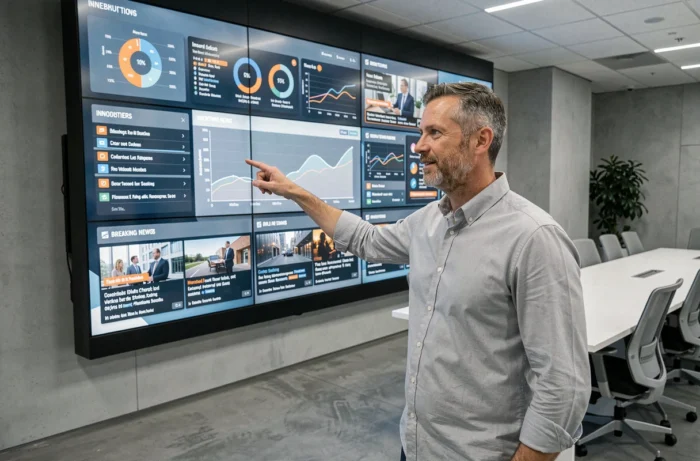
Next Generation Technology Watch: Structuring Your Information Search
Reading one article a week on AI does not constitute monitoring. In the field, it is observed that the most responsive teams combine three complementary channels to not miss out on the innovations and data that matter.
- Specialized newsletters that filter out the noise: they condense product announcements, regulatory updates, and feedback into a format readable in a few minutes
- RSS feeds or targeted alerts on AI models, sovereign cloud solutions, and cybersecurity standards, to capture weak signals before they become media trends
- Internal channels (Slack, Teams, company wiki) where each team member shares a commented link each week, creating a cumulative effect without individual overload
Regularity matters more than volume. Fifteen minutes a day on curated sources is better than an hour wasted scrolling through general news feeds. The goal is not to know everything, but to spot what directly impacts your project or production.
Prioritizing Topics According to Their Operational Impact
Not all innovations deserve the same attention. It is recommended to classify each piece of information captured according to two criteria: the time before impact on your activity, and the level of investment needed to adapt.
A new “Zero Trust” cybersecurity standard applicable in six months requires immediate action. A prototype of a quantum chip announced without a commercialization date can wait. This sorting avoids paralysis by over-information and refocuses monitoring on what generates concrete decisions.
Sustainable Innovations and Data: Research Areas to Watch
Sustainability is no longer a marketing argument. Companies developing next-generation technical solutions now integrate environmental impact criteria from the design phase. This trend is observed in three specific areas.
Hybrid and sovereign cloud is rapidly advancing in Europe, driven by players responding to a triple imperative: data sovereignty, enhanced security, and reduced carbon footprint. For technical teams, this means reassessing hosting providers and verifying where production data actually transit.
Edge computing coupled with industrial IoT is transforming on-site data collection. Instead of sending everything to a central server, processing occurs as close to the source as possible. Gains in latency and energy consumption are measurable, and this architecture is becoming a standard in industrial production.

Explainable AI (XAI) is gaining ground because it meets a concrete demand from regulators and customers: understanding why a model makes a decision. In the financial or medical sector, an opaque model is no longer deployable without technical justification.
AI Adoption in Companies: Field Results Nuance the Promises
According to the Banque de France, AI is rapidly establishing itself in French companies, but immediate productivity gains remain to be confirmed. This observation, far from being discouraging, reminds us that the integration of disruptive technology rarely follows a linear curve.
In the field, it is observed that the first months of adoption mainly serve to train teams, adjust processes, and identify genuinely profitable use cases. Companies that expect instant return on investment risk giving up too soon.
- Phase 1: experimentation within a limited scope (a service, a product, a repetitive task) to measure real gains without disrupting production
- Phase 2: industrialization of validated use cases, with user training and documentation of observed limitations
- Phase 3: gradual extension, integrating feedback from teams to correct biases and improve model relevance
Companies that document each step progress faster than those that deploy massively without capitalizing on feedback. The search for productivity goes through this field discipline.
Adapting Your Monitoring Model to the Speed of Innovations
The pace of announcements regarding AI techniques and solutions renders any quarterly monitoring obsolete. An effective model relies on a minimum weekly frequency, with a monthly summary point to arbitrate investments.
Each technological project deserves its own monitoring thread. Mixing AI regulation, hardware trends, and software innovations in a single channel produces noise, not clarity.
The next regulatory constraint or technical disruption will not give advance warning. Structuring your monitoring on Next Generation innovations is equipping yourself to act before being forced to react.