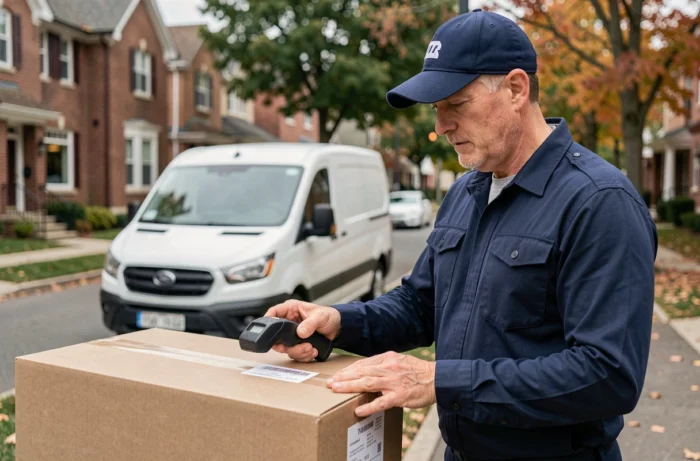
Express delivery is not just about a fast carrier. The optimization of express deliveries relies on precise technical trade-offs, from sizing shipping slots to managing delivery failures, along with controlling last-mile costs that continue to rise.
Last-mile cost in express delivery: the priority area to manage
The last mile represents the heaviest share of the total cost of an express shipment. According to FreightWaves, last-mile costs have increased by 12% for the second consecutive year in 2026. This inflation is no longer cyclical; it is becoming structural.
We observe that companies that master this area are not only looking to speed up delivery. They invest in reducing the delivery failure rate, a lever often underestimated. Each failed delivery attempt triggers a return to the depot, a rescheduling, and a new trip. In an express flow, this additional cost can wipe out the order’s margin.
To contain these costs, three operational levers should be activated simultaneously:
- Ensure reliable address collection at the time of order (automatic validation, geocoding) to eliminate errors that lead to delivery failures
- Offer tight delivery slots with active confirmation from the recipient, rather than a wide slot that increases the risk of absence
- Centralize carrier management on a single platform to compare actual performance by geographic area and type of package
Platforms like speeder.fr allow for comparison and management of express transport offers by consolidating this operational data.

Optimizing express routes with AI: beyond GPS
Route optimization software incorporating artificial intelligence no longer just calculates the shortest route. They now integrate dynamic variables: real-time traffic conditions, historical availability slots of the recipient, access constraints to urban areas.
AI reduces traveled distances and the number of failed delivery attempts, which directly affects cost and timing. We recommend testing these tools in a limited scope (a city, a type of package) before deploying them across the entire network.
A technical point often overlooked: the quality of input data. An optimization algorithm fed with incomplete addresses or approximate package weights will produce suboptimal routes. The reliability of the result directly depends on the quality of the logistics reference.
Low-emission zones and urban express delivery
The proliferation of low-emission zones (LEZ) in Europe is significantly changing access conditions to city centers for delivery vehicles. In the Netherlands and several European metropolises, restrictions are gradually extending to thermal vans, including during the usual express delivery time slots.
Adapting the fleet to LEZ constraints is becoming an operational prerequisite, not a marketing argument. A carrier that can no longer access a dense area between 7 AM and 11 AM loses its ability to deliver express in that sector. We observe that some operators are starting to price deliveries differently in LEZ areas, which directly impacts the shipping cost.
For shippers, the question is no longer whether their carrier has compliant vehicles, but whether express coverage remains effective in the affected areas. A regular audit of delivery capabilities by zone has become necessary.

Managing cross-border express shipments after the 2026 customs reform
The European regulation 2026/382, applicable since July 1, 2026, has removed the exemption from customs duties on low-value shipments. In practical terms, every express package entering the EU is now subject to a duty calculation, regardless of its amount.
For e-commerce merchants shipping to or from third countries, this reform potentially lengthens the customs clearance time if the declarative data is incomplete. The description of the contents, declared value, and tariff code must be accurately provided from the labeling stage.
The impact on express delivery is direct: a package stuck in customs loses its express nature. We recommend integrating the automatic generation of customs documents into the shipping flow, upstream of picking, to avoid chain disruptions.
Key indicators to manage the performance of your express deliveries
Measuring customer satisfaction with delivery is not enough. We recommend tracking specific operational indicators that allow action before the issue escalates to customer service.
- First-attempt delivery rate: this is the indicator most correlated with last-mile profitability. A rate below the industry average signals a problem with slots, addressing, or communication with the recipient
- Average time between order validation and handover to the carrier: this internal downtime is often the primary cause of missed deadlines
- Actual cost per delivered package (including retries and returns): comparing this figure to the carrier’s list price reveals the hidden cost of delivery failures
- Delivery-related complaint rate, broken down by carrier and by zone: helps identify the weak links in the network
Implementing a dedicated dashboard for these metrics, fed in real-time by carrier APIs, transforms the logistical management of a cost center into a customer loyalty lever.
Optimizing express deliveries hinges on technical details that generalist approaches overlook. Between the structural rise in last-mile costs, new European regulatory constraints, and evolving urban restrictions, every link in the shipping chain deserves regular auditing. Gains are rarely found in raw speed, but in reducing friction at every step of the package’s journey.