Your windows let in a draft of cold air in winter, or condensation forms between the two panes. These everyday signs raise a concrete question: is your double glazing compliant with current requirements? The answer is not simply about counting the number of panes. Several technical criteria, often invisible to the naked eye, determine whether a window meets the standards of mandatory double glazing.
Thermal coefficients: the true indicators of a window’s compliance
Having two panes is not enough. What matters is the measurable performance of the entire glazing plus frame. Two coefficients help to decide.
The Ug measures the insulation of the glazing alone. The lower this number, the less heat escapes through the pane. According to the requirements related to RE 2020, a Ug of less than 0.7 W/m².K is expected for new constructions.
The Uw, on the other hand, evaluates the complete window (glazing, frame, spacer). A Uw not exceeding 0.8 W/m².K corresponds to the performance level aimed for in new builds. To understand the standards of mandatory double glazing, you need to look at these two values together, not just one or the other.
Have you ever noticed a label stuck on the frame of your window? It often contains these coefficients. If it has disappeared, the manufacturer’s technical sheet or the original quote mentions them. Without this data, it is impossible to know if your window meets the regulatory threshold.
CE marking and CEKAL certification: two benchmarks to check on your windows
The CE marking is mandatory for all windows sold in the European Union. It guarantees that the product meets a minimum baseline of safety and performance. Its absence on a recent window is a warning sign.
The CEKAL certification attests to the quality of the insulating glazing based on three criteria: airtightness, thermal insulation, and acoustic insulation. It is categorized into classes.
- Thermal classes (TR) range from TR1 to TR14. The higher the number, the better the insulation. A standard double glazing typically falls within the first classes, while enhanced insulation glazing reaches the higher classes.
- Acoustic classes (AR) range from AR1 to AR6 and measure the reduction of external noise. A property by the road does not have the same needs as a house in a rural area.
- The Acotherm label complements CEKAL by combining thermal (Th) and acoustic (Ac) performance into a single ranking, making it easier for a non-specialist to understand.
To find this information, look for the CEKAL mention engraved on the spacer of the glazing (the metal strip between the two panes) or in the documentation provided during installation.
Double glazing in rental properties: what the regulations really require
Confusion is common. Double glazing is not mandatory in all housing. However, to rent out a property, the owner must provide decent housing as defined by law. Since the tightening of energy performance criteria, a property classified as a thermal sieve in the DPE can no longer be offered for rent.
In practical terms, if your single-glazed windows significantly lower the energy performance diagnosis of the property to the point of pushing it into class F or G, the owner must undertake renovation work. Replacing the windows with high-performance double glazing is one of the most direct levers.
DPE and windows: the direct link
The diagnostician takes into account the type of glazing, the material of the frame (PVC, aluminum, wood), and whether or not there is an air gap or argon gas between the panes. Single glazing greatly degrades the DPE score, sometimes by two full classes compared to recent double glazing.
Are you a tenant and your windows seem old? Request the DPE of the property. If the energy class is poor and the glazing is to blame, you have recourse to request compliance.

Lighter test and visual inspection: check your glazing yourself
Before calling in a professional, a few simple checks can provide an initial indication.
The lighter test allows you to distinguish between single and double glazing. Hold a flame in front of the pane. Single glazing produces a single reflection. Double glazing produces four (two per pane). If you see two offset reflections with a slightly different tint, that’s a good sign: it means a low-emissivity coating is present, typical of enhanced insulation glazing.
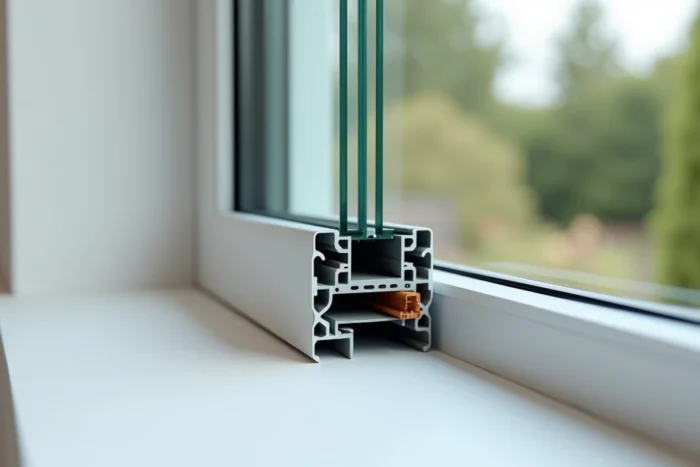
- Look at the spacer between the two panes. A standard aluminum spacer creates a thermal bridge. Recent models use a “warm edge” spacer made of composite material, which is significantly more efficient.
- Check the condition of the seals. A dry, cracked, or detached seal compromises the airtightness of the window, even if the glazing itself is correct.
- Observe the inside of the double glazing. Fogging or condensation between the two panes indicates a seal failure. The glazing has lost its insulating gas, and its thermal performance is degraded.
These checks do not replace a professional diagnosis, but they help identify the windows that need to be prioritized for replacement.
Old windows and renovation: when replacement becomes the only option
Some original wooden windows, installed in the 1970s or 1980s, feature first-generation double glazing. The problem: this old glazing offers thermal insulation well below current standards. The air gap between the panes is often thin, without argon gas, and the Uw coefficient far exceeds the recommended thresholds.
Replacing only the glazing does not always solve the problem. If the frame is warped, if drainage is absent, or if the dimensions do not allow for thicker glazing, a complete window replacement is necessary.
The choice of frame material (PVC, aluminum, or wood) also affects the final Uw coefficient. With identical glazing, an aluminum frame without thermal break will be less efficient than a multi-chamber PVC frame. This detail can sometimes change the DPE class of the property.
Before starting renovation work, obtain several quotes detailing the Uw and Ug coefficients of the proposed products. A serious craftsman will mention these values. Their absence on a quote should alert you just as much as an abnormally low price.