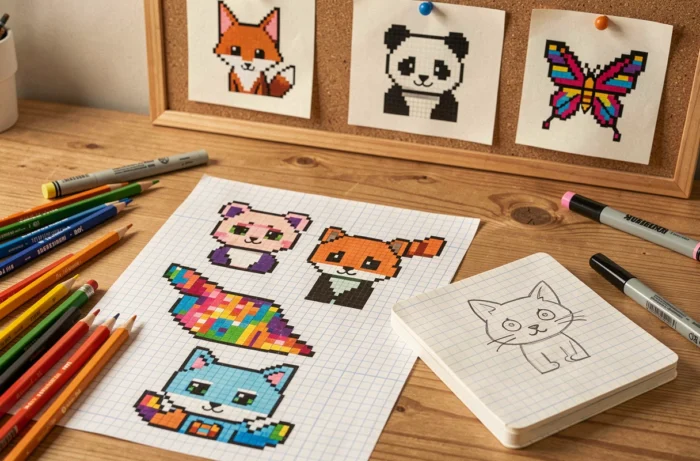
Animal pixel art remains one of the most accessible entry points for those discovering this practice. A few colored squares on a grid are enough to create a cat, a panda, or a fish. The models presented here are designed for small grids, with a limited number of colors, making them achievable on graph paper as well as on screen.
1. Sitting Cat in Profile
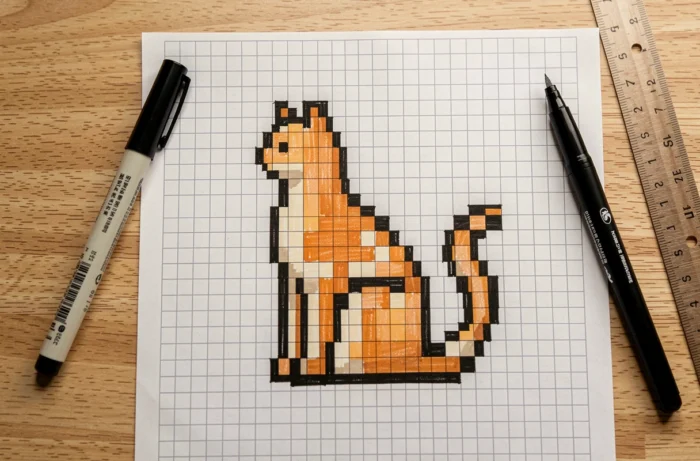
The cat is the most reproduced model in animal pixel art. Its recognizable silhouette fits on a grid of eight squares per side with only two colors (black and white, or gray and pink for the ears).
To achieve a readable result, start with the triangular ears at the top of the grid, then move down to the rounded body. The eyes each occupy a single square. This model is suitable for children from the first grade, as it requires little spatial awareness.
If you’re looking for other easy and cute animal pixel art, the cat remains the ideal base before moving on to more complex shapes.
2. Panda Facing Forward
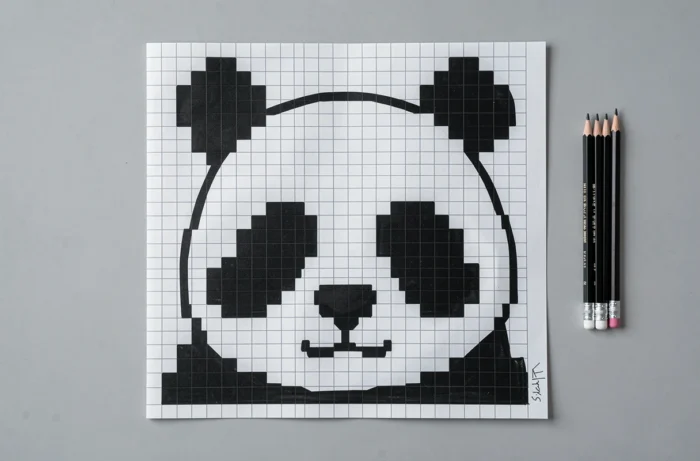
The panda works remarkably well in pixel art thanks to its natural black and white contrast. Two colors are enough for an immediate rendering. The round head is built on a symmetrical base, which simplifies the counting of squares.
The black patches around the eyes are the detail that makes the character identifiable. Place them on two squares on each side of the nose, and the panda appears unmistakably.
3. Tropical Fish
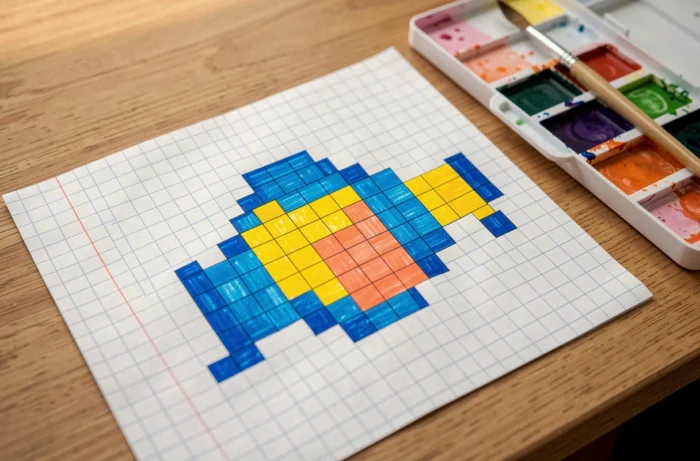
The fish is a good excuse to introduce several colors without complicating the shape. The oval body fits on six squares wide, the tail on two additional columns.
The educational interest lies in the freedom of palette: orange and blue, yellow and purple, the combinations are open. Recent educational resources recommend staying under three or four colors for beginners to limit cognitive load.
4. Rabbit Facing Forward
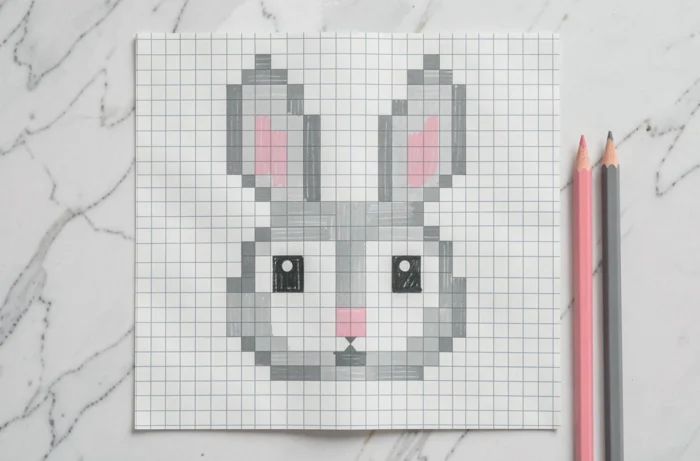
The long ears of the rabbit pose the main challenge of this model. They occupy four to five squares in height, which elongates the grid vertically.
The rest of the body remains compact. A rectangle three squares wide for the torso, two squares for the legs. The nose is represented by a centered pink square. This model is particularly appealing to children who want a “cute” result quickly.
5. Owl on a Branch
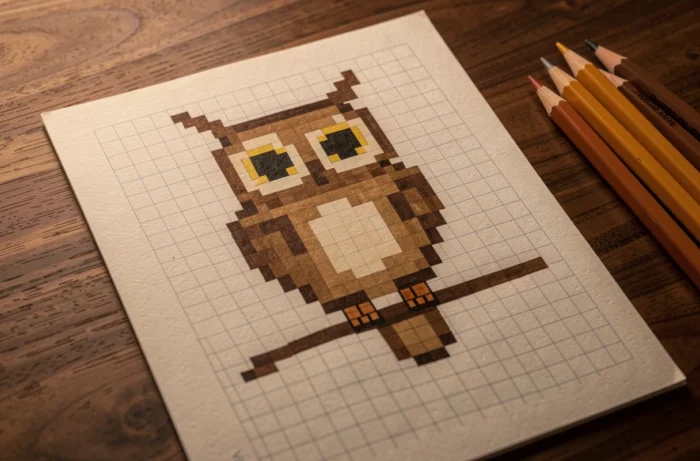
The owl allows for working with concentric circles in pixel art. The eyes, each two squares wide, dominate the composition. The stocky body is built around them.
Add a horizontal brown line under the feet to represent the branch. This contextual detail transforms a simple animal into a small scene, without significantly increasing the difficulty.
6. Sitting Fox
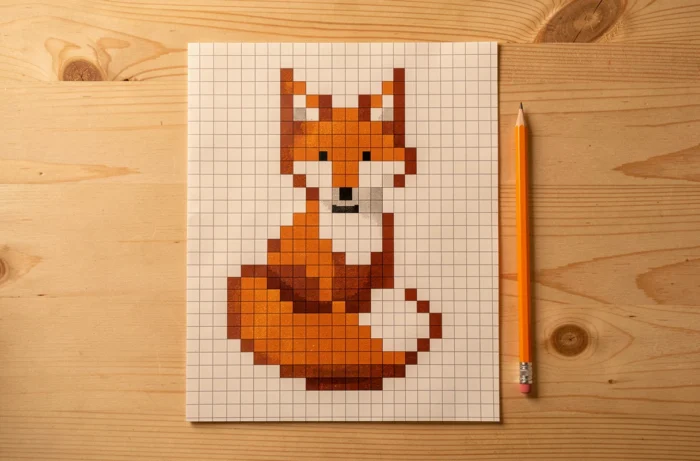
The fox requires a minimum of three colors: orange, white, and black. Its triangular shape (pointed snout, upright ears) distinguishes it from the cat and offers a logical progression after this first model.
The white V-shaped snout is the visual marker to place first. The rest of the head is built around it. The bushy tail, two squares wide, completes the silhouette to the right.
7. Simplified Elephant
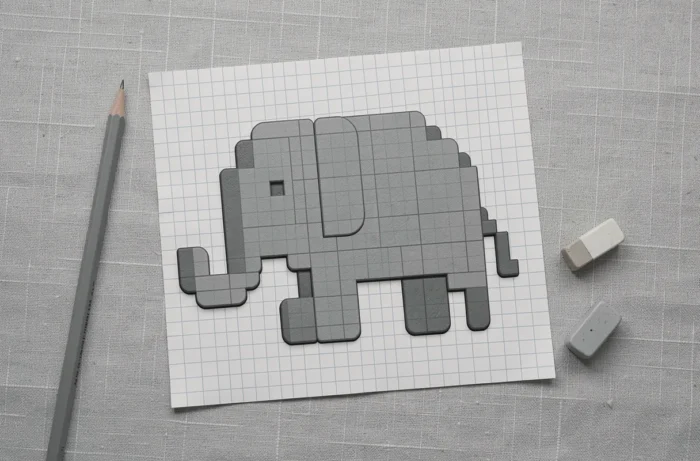
Representing an elephant in pixel art poses a proportion problem: the trunk elongates the silhouette. The solution is to fold the trunk down over two squares, keeping the model within a reasonable square.
One gray color is sufficient, with a pink square for the inside of the ear. This minimalism makes it an effective exercise to understand how to suggest volume with very few pixels.
8. Symmetrical Butterfly
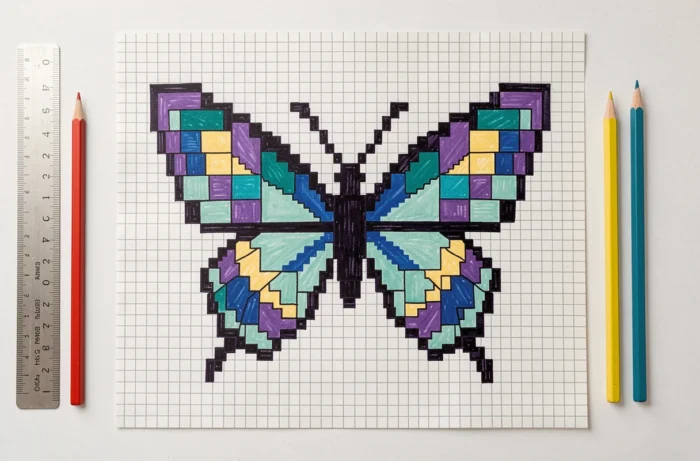
The butterfly is the ideal model for teaching axial symmetry. Draw the left half, then reproduce it as a mirror image. This technique divides the work in half and reduces counting errors.
The wings can accommodate as many colors as desired. Four bright colors on a white background create a striking result, even on a modest grid.
9. Turtle from Above
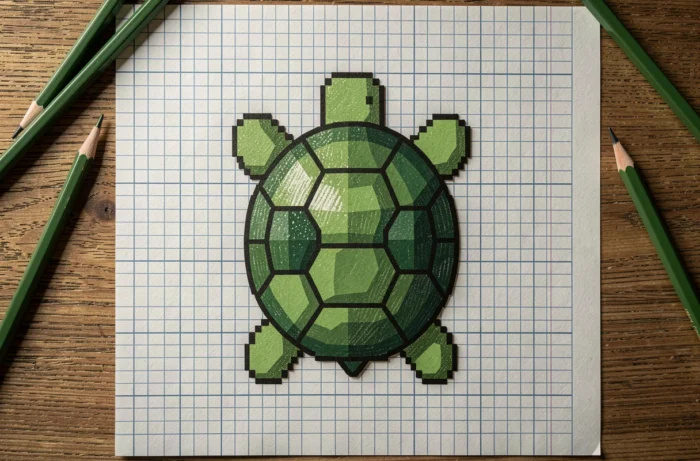
The turtle’s shell lends itself to a checkerboard or simplified hexagon pattern. The dark green oval body occupies the center, with the legs extending one square on each side.
This model introduces the notion of repetitive pattern within a shape, a useful concept for progressing to more elaborate compositions.
10. Bust of a Giraffe
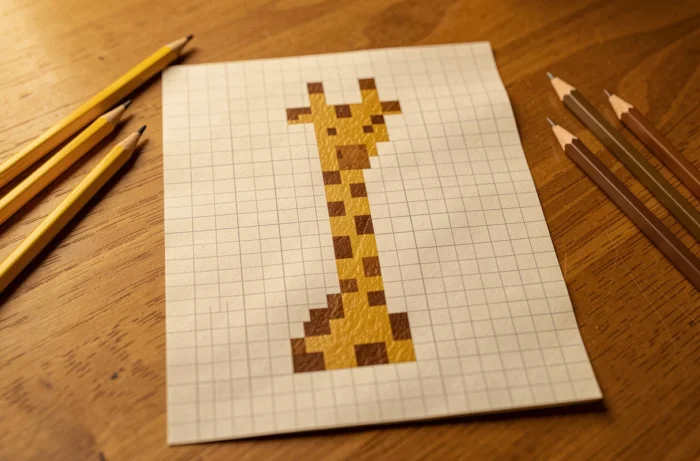
The complete giraffe would need a very tall grid. By limiting it to the bust (head, neck, beginning of the body), the model remains manageable on a grid of ten squares per side.
The brown spots on a yellow background are placed irregularly, freeing the beginner from the constraint of symmetry. The two small horns (ossicones) each occupy one square at the top of the head.
11. Penguin Facing Forward
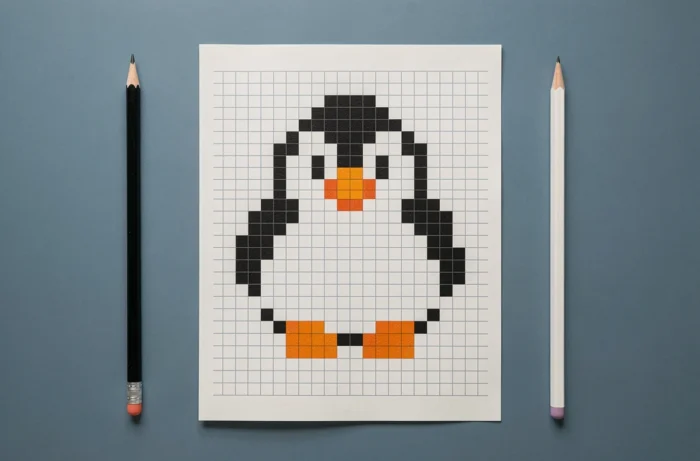
Black, white, and orange for the beak: the penguin is constructed with three colors on an oval base. The white belly forms an inner oval, framed by the black of the back and wings.
Its compact and symmetrical shape makes it a quick model to finish, suitable for short sessions in class or at home.
12. Jack Russell Dog
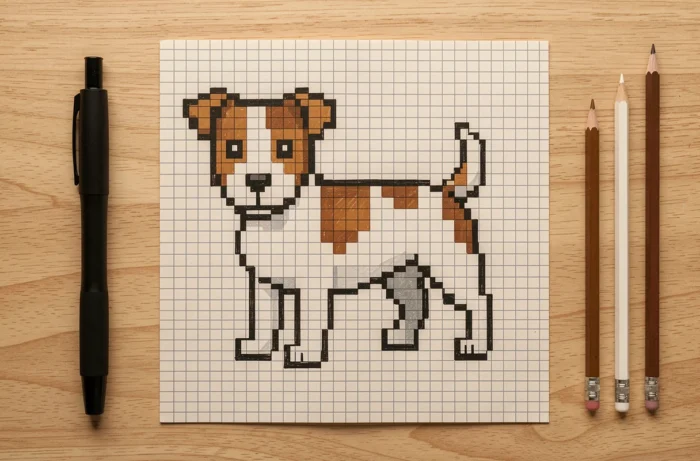
The Jack Russell, with its brown spots on a white background, offers a simple dog model to reproduce. The round head, drooping ears, and spot on the eye are enough to identify the breed.
Compared to the cat, the dog requires more detailed work on the ears (drooping and not upright). Two additional squares down for each ear make all the difference.
13. Bee in Flight
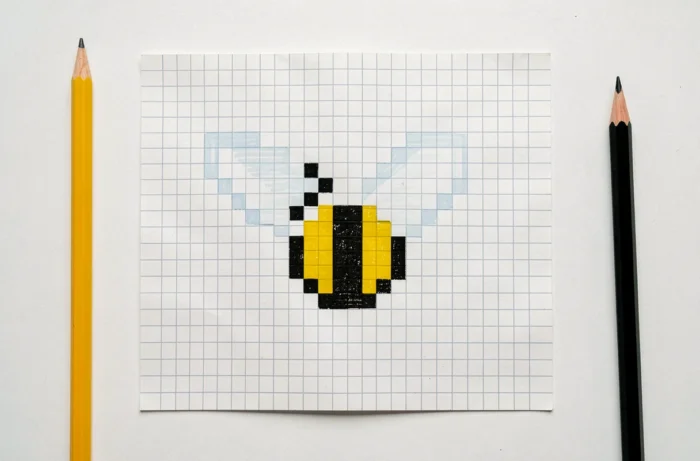
The bee combines horizontal yellow and black stripes on a body six squares wide. The wings, represented by two light blue squares on each side, create the impression of flight.
The stinger occupies a single square at the bottom. This model teaches regular color alternation, a grid spotting exercise that primary teachers use as a remediation activity.
14. Frog on a Lily Pad
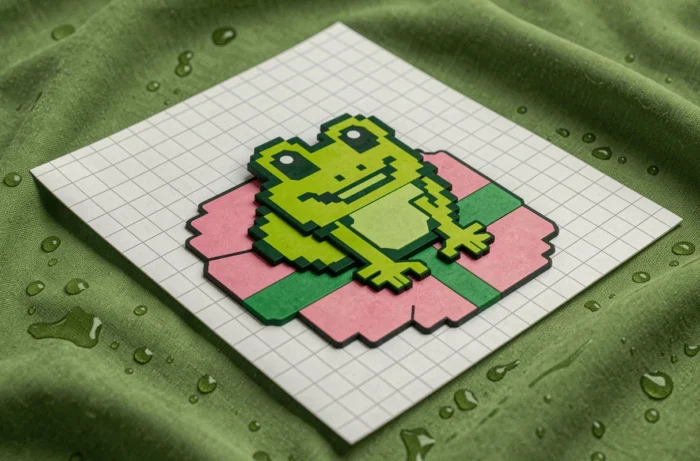
The green sitting frog is summarized as a rectangle topped with two bulging eyes. Each eye extends one square above the head, giving the character its characteristic expression.
The lily pad below (a wider green line than the body) adds a decorative element without complicating the drawing. Three shades of green make the scene more readable.
15. Lion with Mane
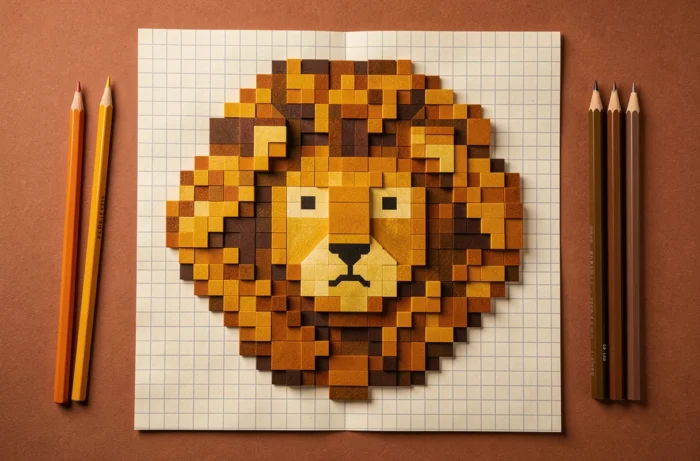
The lion concludes this selection with a slightly more ambitious model. The mane, which surrounds the head on all adjacent squares, requires precise counting.
Use orange for the mane, yellow for the face, and black for the eyes and nose. The result fits on a grid of about twelve squares per side.
- Start with the mane by filling a solid square, then hollow out the center for the face
- Place the eyes symmetrically on the same horizontal line
- Add the snout on two centered squares below the eyes
Each of these models can be created on graph paper with colored pencils or markers, but also on applications dedicated to pixel art. The transition from paper to screen does not change the construction logic, only the medium differs. For teachers who use pixel art as a teaching tool, these animals cover a progressive spectrum: from the minimalist cat to the maned lion, the difficulty increases without ever becoming discouraging.