
A homemade vegetable candle relies on three components: a plant-based wax (soy, rapeseed, coconut), a natural fiber wick, and optionally, a fragrance. The difference from a classic paraffin-based candle lies in the raw material of the wax, which determines the melting point, surface finish, and burning behavior.
Fine particles and air quality: how the choice of vegetable wax makes a difference
The combustion of a candle, regardless of the wax, can become the main source of ultrafine particles in a home during a burning session of one to two hours. This finding, documented by research compiled by HongKongCAN and a study published in 2025 in Nature Scientific Reports, explains the growing recommendations for plant-based waxes.
Favoring soy, coconut, or beeswax reduces the load of petroleum-derived compounds. However, this is not enough to guarantee healthy air: the type of wick and the duration of combustion are just as important as the wax itself. Wicks with a metal core, still found in some cheap kits, should be systematically avoided.
To delve deeper into the principles underlying the making of homemade vegetable candles, the choice of wax remains the first technical decision to master before moving on to pouring.
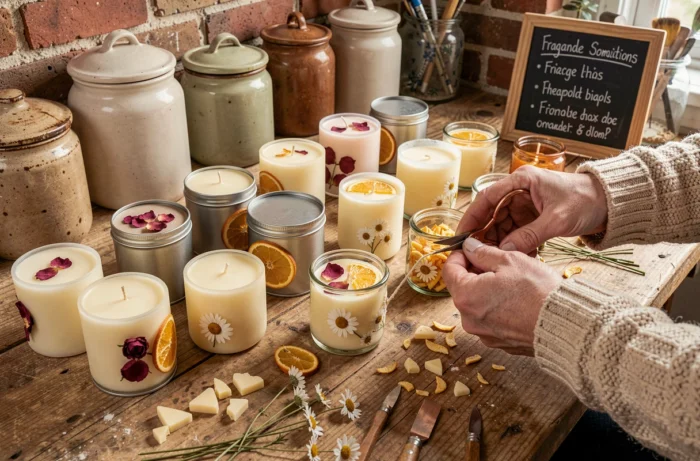
Melting point and pouring temperature: the often-overlooked technical parameter
Each vegetable wax has its own melting point. Soy wax melts at a lower temperature than beeswax, which directly modifies two variables: the temperature at which to pour the wax into the container and the cooling speed.
Why pouring temperature affects the final result
Pouring wax that is too hot causes surface dimples (called “sinkholes”) and visible shrinkage around the wick. Pouring too cold prevents the wax from adhering well to the walls of the container, creating unsightly separations.
The ideal pouring temperature is slightly above the melting point, with a margin that varies depending on the wax used. A double boiler remains the most reliable heating method to control this temperature rise without risking overheating.
Slow or fast cooling: consequences for texture
Cooling too quickly (near an open window, in the refrigerator) promotes cracks and fissures. Cooling at a stable room temperature, away from drafts, results in a smooth and even surface. This simple detail makes the difference between a well-crafted artisanal candle and one that cracks the very next day.
Cotton wick for vegetable candle: sizing and centering
The wick determines the quality of combustion at least as much as the wax. A wick that is too thin creates a tunnel (the wax only melts in the center), while a wick that is too thick generates a tall flame, black smoke, and excessive consumption.
Sizing depends on the diameter of the container. Suppliers of coated cotton wicks generally indicate a recommended container diameter for each reference. Adhering to this correspondence avoids most combustion problems.
- Thin wick (small type): suitable for small diameter containers, it limits the melting pool to prevent overheating of the glass.
- Medium wick: the most versatile choice for standard votives and jars, ensuring a regular melting pool.
- Wide wick: reserved for large containers or dense waxes like beeswax, which require more heat to melt evenly.
The centering of the wick is done before pouring, using a wick holder or simply two sticks laid across the container. An off-center wick melts the wax asymmetrically and reduces the candle’s lifespan.

Fragrancing a vegetable candle without degrading air quality
The addition of fragrance to a homemade candle raises a question rarely addressed in tutorials: the Regulation (EU) 2023/1545, fully applicable from July 31, 2026, expands the list of fragrance allergens to be declared on labels, increasing from about twenty to around 80 substances. This development directly affects candle makers who sell or give away their products.
In practice, this means that synthetic fragrances often contain several of these allergens. Significant oils are not exempt either: linalool and limonene, found in lavender or citrus, are on this list.
Dosing and timing of incorporation
The fragrance is added when the melted wax has slightly cooled, just before pouring. Incorporating it into wax that is too hot causes partial evaporation of the fragrant compounds, reducing the intensity of the scent once the candle is lit.
- Significant oils: more subtle aromatic load, reserved for fans of discreet notes and users sensitive to composition.
- Cosmetic fragrances: more pronounced intensity, but often more complex composition with more potential allergens.
- Unscented: the safest option to limit volatile organic compound emissions during combustion, recommended in bedrooms and poorly ventilated spaces.
Limiting each burning session to one or two hours and ventilating the room after use remain the most effective gestures, regardless of the type of fragrance chosen. A well-sized vegetable candle, with an appropriate wick and a modestly dosed fragrance, produces significantly less residue than an industrial paraffin-based candle, but it is not entirely neutral for indoor air.