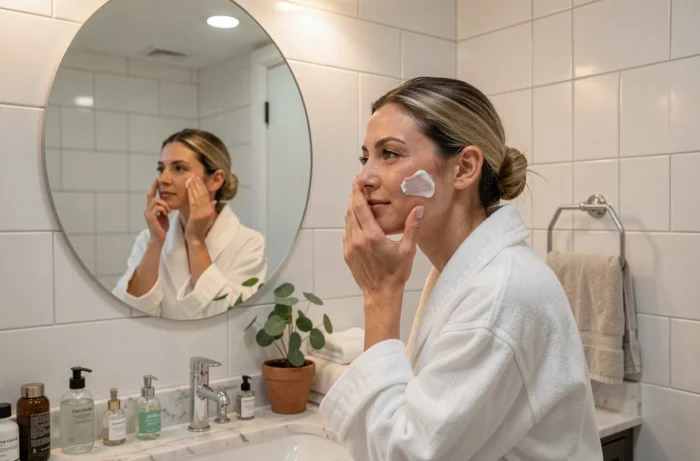
A cream applied in a hurry, a cleanser chosen randomly from a shelf, a serum whose exact function is unknown: most beauty routines are built on accumulation rather than logic. The result is a cluttered bathroom and skin that doesn’t really respond any better than before. Elevating your daily beauty routine doesn’t come from using more products, but from a better understanding of what your skin needs.
New allergen labeling rules: what your face cream will reveal
Have you ever turned a bottle around to read the ingredient list, only to give up in the face of a series of incomprehensible names? This reading will soon become more useful. Regulation (EU) 2023/1545, adopted in July 2023, requires cosmetic manufacturers to declare more than 80 fragrance allergens on the label, compared to about twenty previously.
Starting from July 31, 2026, any new product launched on the European market must comply. Products already on the shelves can be sold until July 2028. For daily face and body care, the consequence is direct: so-called “natural” formulations, rich in essential oils or botanical extracts, will see their labels become denser. Menthol, vanillin, camphor, certain essential oils – all substances that can now be identified.
For sensitive or reactive skin, this is a real gain. Spotting a specific allergen in a leave-on product (declaration threshold at 0.001%) allows for the elimination of the cause of recurring irritation rather than blindly switching brands.
Before adding a new serum or moisturizer to your routine, make it a habit to photograph the INCI list and compare it with your previous products. Many ideas for suitable treatments for reactive skin are detailed in the beauty section of Mademoiselle Camille, with approaches that prioritize transparency in formulations.

Morning and evening skincare routine: building a sensible order
The order of application of skincare products is not a marketing detail. It is based on a simple principle: lighter textures go before richer ones. A watery serum penetrates poorly if a thick cream has already formed an occlusive film on the skin.
In the morning, protect above all
The morning cleanse doesn’t need to be aggressive. A simple rinse with lukewarm water or a swipe of micellar water is enough to remove the sebum accumulated overnight. Next comes hydration, followed by sun protection. This last step is the one that most routines neglect, even though it conditions the long-term quality of the skin much more than an anti-aging treatment.
In the evening, repair deeply
Makeup removal is the only time when the skin really needs a thorough cleanse. A milk or balm dissolves makeup and pollution residues. A second pass with a gentle cleanser (double cleansing method) removes what the first has loosened without stripping.
After cleansing, it’s time to apply concentrated actives. Acid-based or retinol serums work better on clean, slightly damp skin. Finish with a cream or oil to seal in hydration.
- Gentle cleanser or micellar water in the morning, double cleansing in the evening to remove makeup and pollution
- Serum before cream, always from the most fluid to the thickest, to maximize active ingredient penetration
- Sun protection every morning, even in winter or on cloudy days, as the last step before makeup
Body and hair care: often rushed gestures
The beauty routine doesn’t stop at the face. The skin on the body represents the largest surface area of the body and yet rarely receives as much attention. Applying a moisturizing treatment right after the shower, on still damp skin, significantly improves absorption. There’s no need to invest in an expensive product: a basic body balm applied regularly yields better results than a premium treatment used once a week.
When it comes to hair, the reflex to question is the washing frequency. Daily shampooing is suitable for some oily scalps but dries out most others. Spacing washes to two or three times a week, alternating with a simple rinse, allows the scalp to rebalance its sebum production.

Everyday makeup: fewer products, more radiance
Makeup that enhances the complexion daily relies on a well-prepared base, not on piling on layers. If hydration and sun protection are in place, a simple targeted concealer for imperfections often replaces a heavy foundation.
Have you ever noticed that your makeup holds less well on certain days? The cause is rarely the product itself. Makeup that doesn’t last often signals poorly prepared or dehydrated skin. Before changing your foundation, check the preceding step.
- A hydrating primer smooths the skin texture and extends makeup wear without weighing it down
- For the eyes, a blended pencil gives a more natural result than a rigid eyeliner for everyday use
- Setting with a light mist rather than a mattifying powder preserves the radiant effect on the face
PFAS in cosmetics: a criterion to watch
France has introduced a ban on cosmetic products containing PFAS (per- and polyfluoroalkyl substances) through law n° 2025-188 of February 27, 2025. These compounds, used for their smoothing or water-resistant properties in certain foundations, mascaras, and sunscreens, raise serious environmental and health concerns.
Checking for the absence of PFAS is becoming a relevant reflex when choosing a new makeup product or body care. The labels “PFAS-free” or “without PFAS” are starting to appear on some packaging. In the absence of indication, searching the INCI list for terms containing “fluoro” helps identify these substances.
Choosing products that are more transparent about their composition is not a militant stance. It’s a concrete way to align your daily beauty routine with the latest regulatory requirements while reducing exposure to substances whose risk profile remains under scrutiny.