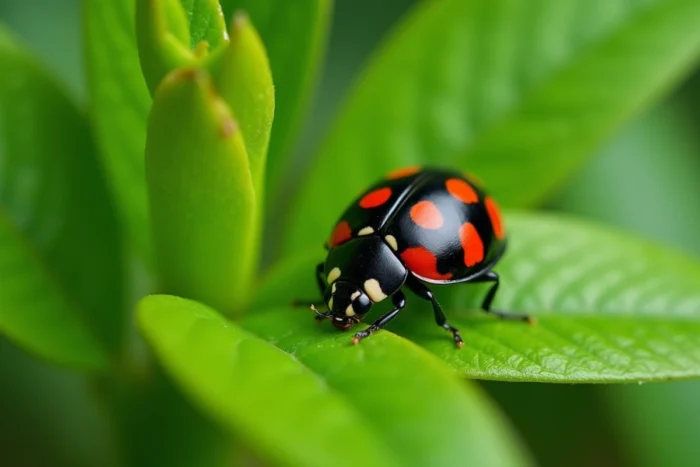
The black ladybug with red spots intrigues both gardeners and nature enthusiasts. Before attributing a symbolic meaning to it, a more concrete question arises: which species are we dealing with, and what do the color and arrangement of its spots really reveal about its biological identity?
Asian ladybug or local species: identification chart by spots
The vast majority of black ladybugs with red spots observed in Europe correspond to a form of the Asian ladybug, Harmonia axyridis. Introduced as a biological pest control agent against aphids in the 1990s, it has since spread widely and competes with European ladybugs.
The table below gathers the visual criteria to distinguish the main species that are often confused in gardens.
| Criterion | Harmonia axyridis (Asian) | Coccinella septempunctata (7-spotted) | Adalia bipunctata (2-spotted) |
|---|---|---|---|
| Dominant color of the elytra | Highly variable: black, orange, red | Bright red | Red or black |
| Number of spots | From 0 to more than 19 | 7 fixed black spots | 2 black spots (red form) or several red (black form) |
| Mark on the pronotum | Black “M” or “W” shaped mark | Two lateral white spots | Black pronotum with a light border |
| Size | Larger than most local species | Medium size | Smaller |
| Winter behavior | Mass aggregations in buildings | Overwintering outdoors | Sometimes in homes, in small numbers |
The most common trap is to rely solely on color. Harmonia axyridis can be red with black spots, orange without spots, or black with red spots. It is precisely this extreme variability in coloration that makes it difficult to identify for a non-specialist. Color alone is never sufficient.
To explore the meaning of the black ladybug with red spots from a numerological and symbolic perspective, other readings complement this naturalistic approach.
The pronotum, a neglected area that settles the identification debate
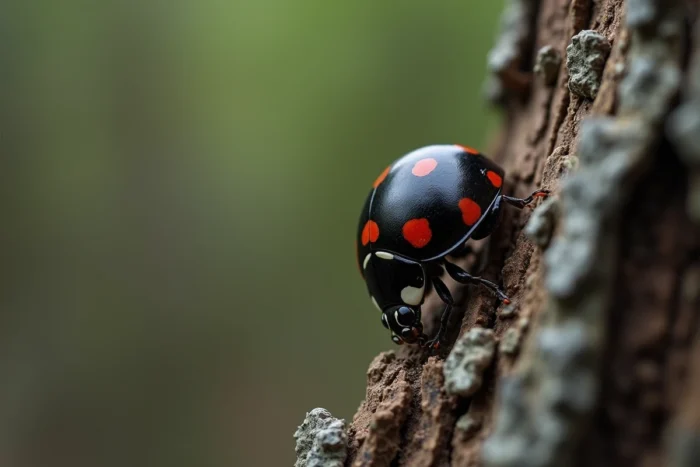
When the color of the elytra does not allow for a conclusion, the pronotum (the small plate between the head and the wings) becomes the decisive criterion. In Harmonia axyridis, this area features a black mark in the shape of an “M” or “W” depending on the angle of observation. This pattern is stable from one individual to another, unlike the spots on the elytra.
European ladybugs do not display this pattern. Coccinella septempunctata shows two white spots on either side of the pronotum. Adalia bipunctata has a largely black pronotum with a thin light border. By gently flipping the insect or observing it from the front, this detail can be spotted in a few seconds.
This area is rarely mentioned in popular content, which focuses on the number of spots. In entomological identification, the pronotum is more reliable than the number or color of the spots.
Legs and secretions: two additional clues
The color of the legs provides a complementary clue. The legs of the Asian ladybug are generally brown-orange. In contrast, those of the seven-spotted ladybug are black.
When handled, Harmonia axyridis secretes a yellowish liquid with a pungent odor, more abundant than in local species. This defensive reflex (reflex bleeding) sometimes leaves traces on fingers or walls of homes in autumn when individuals seek to overwinter en masse inside houses.
Invasive Asian ladybug: real impact on garden species
The issue goes beyond mere entomological curiosity. Harmonia axyridis is classified as an invasive species because it competes directly with native ladybugs on several fronts.
- It consumes the same prey (aphids, scale insects), but in greater quantities due to its size and voracity, which reduces the resources available for local species
- Its larvae are capable of devouring the larvae and eggs of other ladybug species, a documented intraguild predation behavior by entomologists
- Its ability to form aggregations of several hundred individuals in buildings in autumn makes it particularly visible, but also problematic in vineyard areas where it can alter the taste of grapes
Local ladybugs such as Coccinella septempunctata or Adalia bipunctata see their populations decline in areas where the Asian species is well established. The presence of a black ladybug with red spots in the garden is therefore not ecologically neutral.

Spots and symbolism: what biology contradicts
Many online contents attribute a spiritual or numerological significance to the number of spots on a ladybug. According to these interpretations, each spot would carry a message or correspond to a symbolic number.
The biological reality goes in another direction. In Harmonia axyridis, the number of spots varies within the same species, from one individual to another, with no link to age, sex, or any “message.” This variability is genetic and related to larval development conditions.
The fact that the same individual can be black with two red spots or orange with nineteen black spots shows that coloration is not a stable code. In local species, the pattern is more fixed (seven spots in Coccinella septempunctata, for example), but it does not “mean” anything in the symbolic sense.
Why this confusion persists
The ladybug remains one of the insects most associated with luck in European cultures. The red seven-spotted ladybug, called “God’s little creature,” crystallizes this symbolism. When a black ladybug with red spots appears, the visual difference from the familiar model prompts a search for a particular explanation. The answer lies in the diversity of species and the genetic plasticity of Harmonia axyridis, not in a hidden signal.
Correctly identifying the species being observed, by checking the pattern of the pronotum and the size of the insect, remains the only reliable way to know who you are dealing with. In the garden, this identification also conditions the response to be provided: encourage local ladybugs, observe without intervening, or report the presence of the invasive species to participatory science networks.