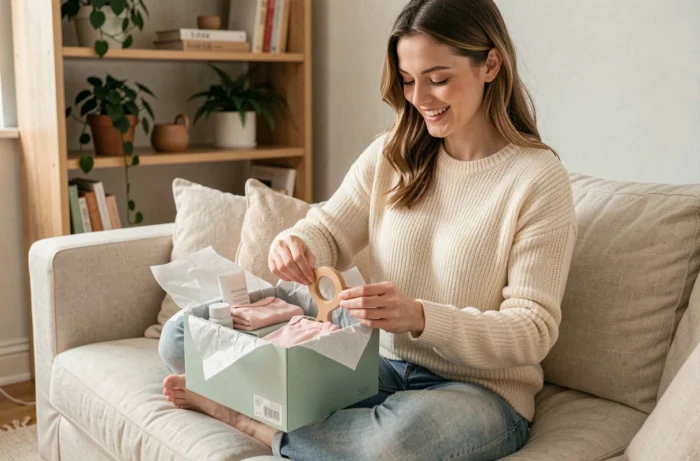
The baby box market has become so dense that sorting through it is difficult, even for parents already familiar with the childcare universe. Choosing the right baby box for the first months requires looking beyond the appeal of the packaging to examine the product composition, the business model, and the real commitments related to the subscription.
Cosmetic composition of baby boxes: what the INCI list reveals
The majority of birth gift sets include at least one topical care product (liniment, diaper cream, cleansing gel). We recommend systematically checking the INCI list before validating a box, even if it is labeled “organic” or “natural.”
A cosmetic product intended for infants must comply with European regulation 1223/2009, which governs marketing, composition, and labeling. The term “hypoallergenic” has no binding regulatory value: it does not require the manufacturer to conduct any specific additional tests.
The most common contact allergens in baby care products are fragrances (even those of plant origin) and certain preservatives. A quality box should exclude added fragrances in any product intended for an infant under three months, a period when the skin barrier remains immature.
- Check for the absence of fragrance (the mention “Fragrance” or “Parfum” at the end of the INCI list) in diaper care products and liniments.
- Prefer formulations with an ingredient list that does not exceed ten components, indicating a simple formulation.
- Ensure that the manufacturer explicitly mentions compliance with European cosmetic regulation 1223/2009 and not just a simple self-declaration of “dermatologically tested.”
Several baby boxes offered on https://bullabebe.com/ detail the composition of each included product, making this verification easier before placing an order.
Free birth gift sets: the real cost behind the offer
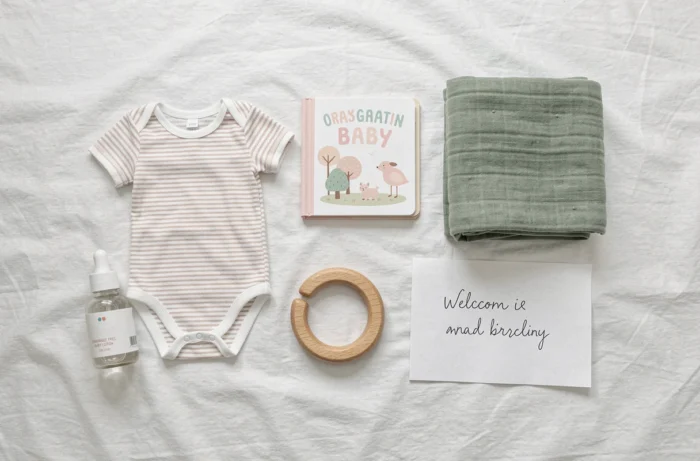
The “free” birth gift sets distributed by certain brands or e-commerce platforms have multiplied in recent years. Their model relies on the mass collection of personal data from young parents, rather than on commercial generosity.
The registration form associated with these offers often contains pre-checked paid subscription boxes. A parent who does not uncheck these options finds themselves committed to a monthly subscription starting the following month, sometimes without clear notification.
We observe the same logic with baby boxes linked to creating a birth list on major platforms: the explicit counterpart is the exploitation of the list data (product preferences, budget, expected delivery date) for advertising targeting. A free box whose real cost is a marketing file is not a gift.
Before filling out a form, checking three points is sufficient: the existence of a pre-checked subscription box, the data retention policy (duration, third-party recipients), and the cancellation procedure if a monthly commitment is triggered by default.
Subscription baby boxes: technical selection criteria
The monthly subscription format is the most common for accompanying the first months. Not all formulas are equal, and the difference rarely lies in the displayed price.
Adaptation to the stage of development
A relevant box adjusts its content to the age of the infant month by month. A grasping rattle has no place in a box intended for a two-week-old newborn, and a teething ring is premature before the fourth month.
Serious operators ask for the exact date of birth and adapt the selection of developmental, care, and textile items for each shipment. Monthly adaptation to motor and sensory development distinguishes a box designed by early childhood professionals from a simple generic assortment.
Transparency about the origin of the items
The content of a baby box often mixes several categories: textiles, developmental toys, cosmetics, childcare accessories. Each category is subject to distinct regulations (CE marking for toys, regulation 1223/2009 for cosmetics, Oeko-Tex or GOTS standard for clothing).
We recommend checking that each item bears its own regulatory marking, and not just a generic label affixed to the box itself. A transparent operator publishes the product sheet for each item before shipping or at the time of order.

Cancellation conditions and commitment duration
Some baby box subscriptions offer a reduced rate in exchange for a six or twelve-month commitment. The question to ask is not the monthly price, but the total cost in case of early cancellation.
- Check if cancellation is possible online without a mandatory phone call.
- Read the conditions regarding early cancellation fees (some operators charge the difference between the reduced rate and the non-committed rate).
- Confirm that renewal is not automatic beyond the chosen initial period.
Baby boxes and birth gift sets: two distinct logics
The confusion between subscription boxes and one-time gift sets remains common. A birth gift set is a one-time purchase, often given by a third party. A subscription baby box is a recurring service addressed to the parents themselves.
The gift set is chosen based on perceived quality upon opening: presentation, coherence of the items with each other, relevance for a newborn. The subscription box is judged over time: regularity, progressive adaptation, cumulative quality-price ratio over several months.
A good birth gift set does not necessarily make a good monthly box, and vice versa. Parents who want month-by-month follow-up benefit from clearly separating these two purchases in their thinking, rather than subscribing to a service based on an attractive first box that is not representative of subsequent shipments.
The final choice rests on a simple arbitration: a one-time gift set to mark the event, a subscription to accompany development. In both cases, reading the compositions, contractual conditions, and regulatory markings offers better protection than a marketing label displayed prominently on the lid.