
The name Baptiste is among the classic French names that one thinks they know without ever really delving into their history. Behind this familiar word lies a linguistic journey that starts in ancient Greece, traverses biblical texts, and lands in French town halls with a very particular trajectory.
From the Greek verb baptizein to the name: a word that describes an action
Before being a name, Baptiste is a verb. The ancient Greek baptizein means to immerse or plunge into water. The term originally referred to a concrete action, without religious connotation: dipping a fabric in dye, submerging an object.
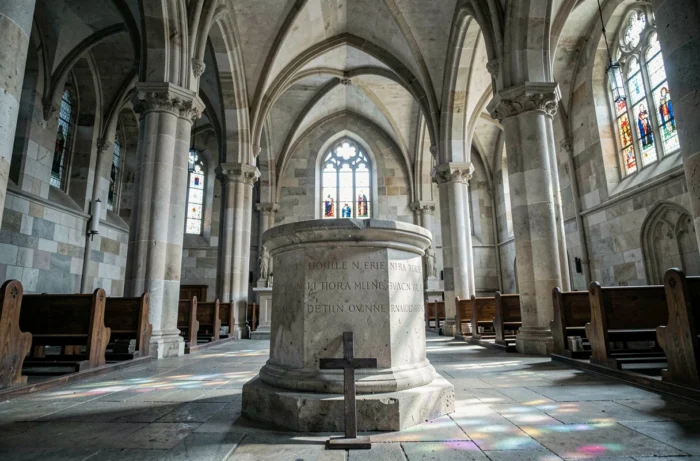
This verb took on a sacred meaning when it was associated with the rite of baptism in the early Christian texts. Immersion in water then symbolized purification and the transition to a new spiritual life. The word shifted from artisanal vocabulary to religious vocabulary, and then to civil status.
This journey explains why, when exploring the origin and history of the name Baptiste, this Greek root is consistently found. The name literally carries within its syllables the trace of an ancient ritual.
John the Baptist in the Gospels: the prophet who gave his name
The name owes its spread to a specific biblical character: John the Baptist, the prophet of the Jordan who, according to the Gospels, baptized Jesus. The nickname “the Baptist” (the one who baptizes) served as a distinguishing title. It allowed differentiation of this John from other figures bearing the same name in the sacred texts.
The feast of Saint John the Baptist is celebrated on June 24. A second date, August 29, commemorates another episode of his life. These two liturgical dates have long influenced the choice of the name in practicing families, who willingly named a child born around these times.
The compound Jean-Baptiste preceded Baptiste alone in usage. For centuries, it was the full form that dominated parish registers. The detachment of the single word “Baptiste” as an autonomous name is a more recent phenomenon in the history of French civil status.
Baptiste as a surname: when the name becomes a family name
You may carry the surname Baptiste without having thought about it. This shift from first name to surname occurred in the Middle Ages when nicknames became fixed as transmissible names. An ancestor named Baptiste, or recognized for his role during baptism ceremonies, may have passed this word down to his descendants.
Several variants of this surname can be found in French and European records:
- Baptiste and Batiste, the most common forms in France, concentrated in certain regions
- Baptista and Battista, Italian and Portuguese variants that testify to the Mediterranean spread of the term
- Bapte, a rarer and archaic form, attested in old records
In France, Baptiste functions both as a first name and as a surname, which is a notable peculiarity. In other European countries, the word is almost exclusively used as a surname.
A French specificity on a European scale
Classic profiles on this name rarely mention this point. Baptiste, as a common first name given at birth, remains a typically Francophone choice. In Italy, Battista exists but is rare at the baptistery. In Spain, Portugal, and English-speaking countries, the word survives mainly in the form of a surname.
This uniqueness can be explained by the anchoring of the cult of Saint John the Baptist in French culture, reinforced by the Saint John’s fires that mark the summer solstice. The name has benefited from a cultural soil that other countries have not nurtured in the same way.

Popularity of the name Baptiste in France: a bell curve
The trajectory of Baptiste in civil status statistics outlines a clear curve. The name saw a gradual rise starting in the 1970s, reaching a peak before beginning to decline.
In the last three available years, Baptiste is significantly down compared to its historical peak. The name is now given several times less than at its height. This real dynamic contrasts with the image of an “timeless” name that many classic profiles attribute to it.
Jean-Baptiste versus Baptiste alone: a gap turned into a chasm
The comparative evolution of the two forms tells a sociological story. Jean-Baptiste, once dominant, has become a very marginal choice compared to Baptiste alone. Parents who choose this name today overwhelmingly opt for the shorter form.
This shift reflects a broader trend in French compound names. Longer forms are declining in favor of shorter names, perceived as more modern. Jean-Baptiste is now a niche, reserved for families attached to the tradition of double names or explicit biblical references.
Several factors explain the appeal that Baptiste held during its decades of high popularity:
- A “-iste” sound that distinguishes it from names ending in “-ien” or “-as” without seeming eccentric
- A religious origin sufficiently discreet to suit both secular and practicing families
- An anchoring in the classic French repertoire, reassuring for parents who avoid overly marked trends
What etymology reveals about the place of the name in French culture
Baptiste carries within it several layers of meaning. The act of immersion, the prophet of the Jordan, the medieval surname, the name of contemporary town halls: each era has added a layer to this three-syllable word.
Its trajectory also illustrates how a name can be both deeply rooted in a religious tradition and perfectly integrated into a secularized society. Most parents who choose Baptiste today do not think of the rite of immersion. The original meaning has faded behind the sound and social image of the name.
The current decline in births under this name does not signify its disappearance. Classic French names experience long cycles. Baptiste has already traversed centuries of use before reaching its modern statistical peak, and nothing prevents a new rebound in the decades to come.